
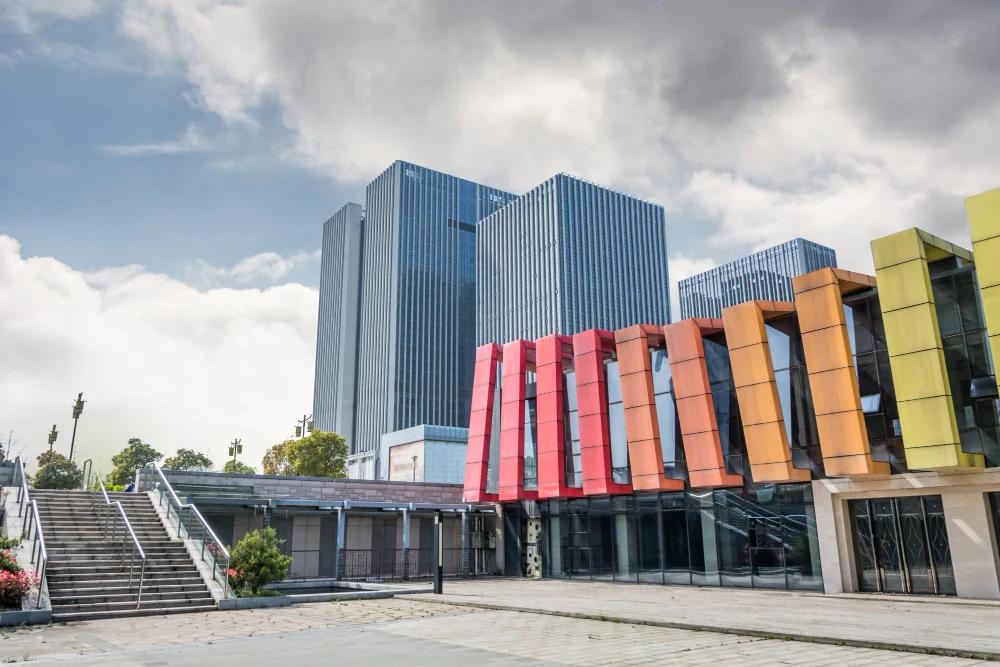
Large-scale commercial building projects involve many parties, including developers, architects, main contractors, MEP subcontractors, and project managers.
In the midst of all this, fire protection often enters discussions late, usually only appearing when permit documents need to be completed.
If you are in the planning or construction process of a commercial building and have not involved a fire protection consultant from the start, then this article is worth reading until the end.
Commercial Project Risks Are Not Only About Construction
Modern commercial buildings, whether mixed-use towers, shopping centers, hotels, or Grade A office buildings, are investment assets with very large values.
One middle-class building in Jakarta alone can cost hundreds of billions of rupiah. At this scale, risks from poorly designed fire protection involve four risk dimensions that commercial building developers and owners need to understand.
1. Investment Value
Fires that cannot be controlled because the system is not optimal can permanently damage assets.
According to NFPA data, the average direct loss per major fire incident in commercial buildings reaches tens of millions of dollars, not including indirect losses.
2. Legal Compliance
Commercial buildings that do not meet fire protection requirements may face serious issues during the SLF (Certificate of Feasibility) process or during Fire Department audits.
In some cases, system non-compliance is discovered after the building is already operational. Remediation costs are greater than if resolved at the beginning.
3. Business Continuity
Commercial building tenants increasingly pay attention to fire safety as part of due diligence before signing lease agreements.
Buildings with a poor track record or reputation in fire safety will have difficulty maintaining good occupancy rates.
4. Brand Reputation
For developers with portfolios of many projects, a single incident in a single building can affect public perception of the entire brand.
Critical Role of Fire Protection Consultants in Commercial Building Projects

1. System Planning from the Concept Phase
Fire protection consultants involved from the start will develop a fire strategy along with the development of architectural design.
This means system requirements such as shaft locations, pump room sizes, fire compartment boundaries, and material types are already accommodated in floor plans from the schematic design phase.
2. Specific Risk Assessment Based on Building Type
Commercial buildings exhibit diverse functional variations within a single building.
Retail floors with high fire load require a different approach than office floors. Underground parking areas with potential electric vehicle fires have different considerations than food courts on the mezzanine floor.
Fire protection consultants conduct hazard assessments for each area, then design systems proportional to the risk profile of each zone.
The result is a system that is neither underdesigned for high-risk areas nor overdesigned for low-risk areas.
3. Preparation of Technical Specifications for Tender
One role of consultants whose value is often not realized is the preparation of technical specifications for the contractor tender process.
Weak specification documents create gaps for contractors to offer products or methods that do not match the project’s actual needs.
Meanwhile, technical specifications prepared by fire protection consultants will include minimum standards, measurable technical parameters, and clear testing requirements.
Why Building Owners Cannot Rely on Contractors Alone?
The answer lies in each party’s position and interests.
Contractors are tasked with executing the design and obtaining margins from materials and labor. In this condition, there is a tendency to choose solutions that are advantageous from the execution and procurement side.
Meanwhile, fire protection consultants do not sell materials and have no interest in certain product brands. They prioritize fire protection systems that work, meet standards, and are efficient in terms of life cycle cost.
Without consultant assistance, owners lack a party that validates that what is proposed and installed by contractors is indeed what is needed.
Studies from the McKinsey Global Institute show that large construction projects, on average, experience 80% cost overruns and 20-month schedule delays.
A significant portion of this overrun stems from poor coordination across disciplines and from design changes. Fire protection consultants who actively coordinate across disciplines can reduce this risk.
Financial Impact If Fire Protection Is Not Designed by Experts
1. Cost Overrun
When fire protection design is made by contractors or parties not competent enough in the engineering phase, errors are often only detected during the coordination of working drawings between disciplines.
At that point, changes already involve drawing revisions, material re-procurement, and in some cases, demolition of what has already been installed.
In medium- to large-scale commercial building projects, fire protection design change costs in the construction phase can reach billions of rupiah, depending on system complexity and the extent of work completed before problems are identified.
2. Functional Testing and Commissioning Failures
Systems designed without an engineering approach often have problems during commissioning. Water pressure is not achieved, sprinkler coverage is inadequate, or alarm systems are not integrated with the BMS.
For commercial buildings with already waiting tenants, handover delays due to commissioning failures will be costly.
3. Risk of Failing Audits and Insurance
Commercial property insurers are increasingly selective in evaluating the quality of fire protection systems before providing coverage and setting premiums.
Buildings with weak design documentation or systems that do not meet standards risk receiving high premiums or, in extreme cases, being rejected for certain types of coverage.
The same applies to the SLF process. Related agencies are increasingly strict in verifying system compliance with applicable requirements. Incomplete design documents or documents that cannot explain the design basis will slow down this process.
Criteria for Choosing Fire Protection Consultants for Commercial Building Projects

1. Similar Project Experience and Large Scale
Ensure consultants have relevant portfolios, not just general fire protection experience. Ask for the detailed engineering scope they worked on in reference projects.
2. Fire Engineering Capability, Not Just Drafting
There is a big difference between consultants who can perform fire engineering analysis and consultants who only create design drawings based on standard templates.
The first can explain why the system is designed with certain parameters. The second cannot answer deeper technical questions.
For high-value projects, you need the first.
3. Independent and Owner-Interest Oriented
Ensure consultants have no affiliation with any vendors or contractors involved in the project. This independence is a basic requirement to ensure objective recommendations.
4. Involved Until Commissioning and Final Inspection
Good consultants must be involved in reviewing contractor shop drawings, supervising installation at critical milestones, and validating, during commissioning, that the system operates according to the design basis.
5. Able to Coordinate with Architects, MEP, and PM
Fire protection design cannot be done in isolation; it must consider the other disciplines involved.
If consultants submit documents without ever meeting with architects, MEP teams, or project managers, there will almost certainly be conflicts that are only discovered when construction is already underway.
Therefore, ensure the consultant you choose actively coordinates across disciplines, not just shows up at the beginning and then disappears.
How Lumeshield Supports Your Commercial Building Projects
Lumeshield is an independent fire protection consultant working to represent owner interests, not product vendors or contractors.
For commercial building projects, our services cover needs from the initial phase through handover.
Fire protection system design services include complete design of sprinkler systems, hydrants, fire pumps, foam systems, gas suppression, and fire alarms, based on hydraulic calculations and in accordance with NFPA, FM Global, and SNI standards.
The process starts with hazard identification per area, followed by system design proportional to the facility’s actual risk profile.
For owners or project managers who want to ensure contractor designs are correct before execution, Lumeshield also provides fire risk assessment services and evaluations of existing systems that can serve as independent quality control mechanisms in your project.
If you are in the planning stage or have entered the design phase of a commercial building project, the Lumeshield team is ready to discuss your project’s specific needs!