

Warehouses are often considered facilities with lower risk compared to factories or process facilities. Unfortunately, this is wrong.
Warehouses used for storing high-value products or commodities in large volumes actually have more complex fire risk profiles.
If you are evaluating whether your warehouse facility is properly protected or planning a fire protection system for a new warehouse, this article will help you understand why fire risk assessment cannot be skipped.
Warehouses Are Not Just Storage Spaces
Suppose there is a distribution warehouse with racks 10 meters high, storing thousands of pallets of consumer products in cardboard and plastic packaging. And, the value of goods inside that room can far exceed the value of the building itself.
So, this is where the problem lies. A fire protection system without understanding the specific risk characteristics of that warehouse does not provide the best protection for the value within it.
Several warehouse characteristics make their risk differ from that of ordinary commercial buildings.
The fuel load is very high because the density and type of goods stored allow a fire to develop very quickly.
High storage racks create a chimney effect that accelerates vertical fire spread. Cardboard, plastic, and foam packaging are flammable fuels.
A general approach that follows only minimum standard requirements, without considering these specific conditions, risks producing underdesigned systems for warehouses with high hazards.
What is a Fire Risk Assessment for Warehouses?
A fire risk assessment (FRA) is a systematic process for identifying fire hazard sources, evaluating who or what is at risk, and determining actions needed to reduce risk to an acceptable level.
In the warehouse context, FRA includes fire load calculation per area, evaluation of stored material characteristics, assessment of existing fire protection system conditions, analysis of safety management and operational procedures, and risk scenario modeling to identify worst-case scenarios.
FRA for warehouses is very different from office buildings. In offices, fire load is relatively uniform and predictable.
In warehouses, fire load can change drastically depending on the type of goods being stored, storage configuration, and stack height.
Which means, FRA for warehouses requires an in-depth understanding of facility operations.
Specific Warehouse Risks Often Overlooked
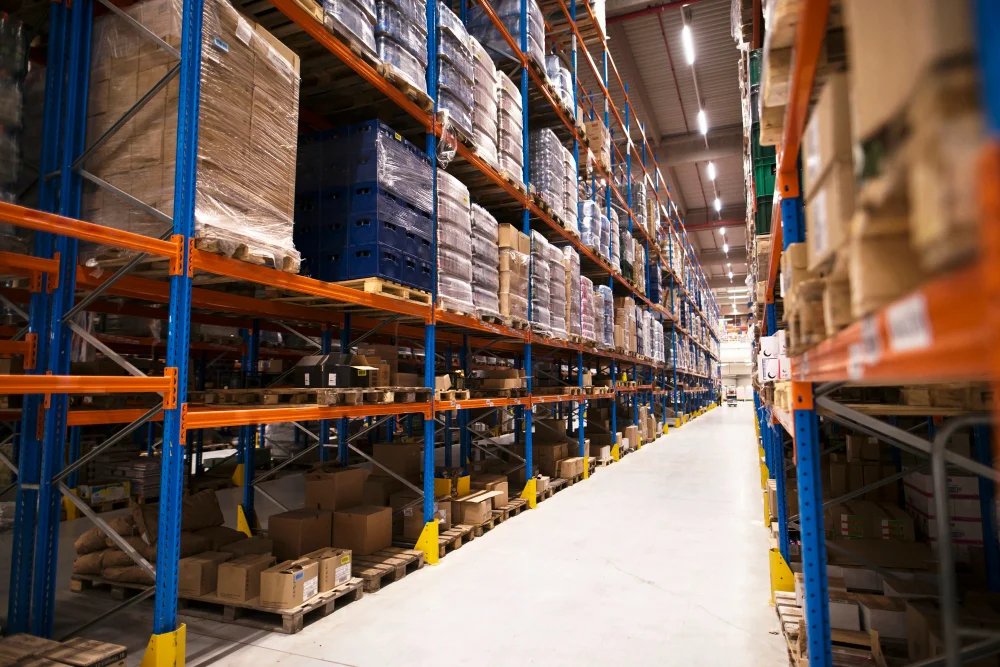
1. High Rack Storage and Vertical Fire Spread
Racks 8 to 12 meters high create conditions different from those of ordinary floor storage. A fire that starts at the bottom of the rack can spread upward quickly through gaps between pallets, exceeding the response time of ceiling sprinklers designed for standard conditions.
This is why NFPA 13 has special requirements for in-rack sprinklers on high-piled storage above certain heights.
Ceiling sprinkler systems alone are not sufficient for high-rack storage with a high fuel load. Proper FRA will identify this gap and recommend appropriate systems.
2. Cold Storage and Extreme Temperature Conditions
Temperatures below zero in cold storage can affect sprinkler head performance, water viscosity in pipes, and the speed of detection system response.
Standard sprinkler head types used in conventional warehouses are not always suitable for cold storage, and incorrect choices can mean the system fails to activate when needed.
Additionally, thick insulation on cold storage walls and ceilings affects heat distribution patterns that directly influence sprinkler activation speed.
3. High-Value Goods Warehouses
Warehouses storing electronics, pharmaceuticals, jewelry, or luxury goods have different protection needs.
Here, water damage from sprinkler systems can be almost as damaging as the fire itself. The value of products damaged by water can reach hundreds of times that of burned products.
FRA for these facilities must consider ways to minimize collateral damage from the system itself. Could mean evaluating alternative suppression systems, such as gas suppression in certain areas or zoning design.
4. 24-Hour Operations and Heavy Equipment Activities
Warehouses operating 24 hours a day with forklifts and heavy equipment have constant ignition sources, from batteries being charged to cables being run over.
Well, a good FRA must consider these operational patterns, not just the building’s physical condition.
Financial Impact If the FRA is Not Done Professionally
1. Large-Scale Asset Losses
According to NFPA data, warehouse and storage facility fires in the United States result in average property losses of more than $ 300 million per year.
In Indonesia, although published national data is limited, several major warehouse fire incidents in recent years have resulted in losses of tens to hundreds of billions of rupiah per incident.
2. Operational Disruptions and Client Contracts
For logistics companies or 3PLs, fires that halt operations result in failed client agreements, contract penalties, and trust that is not easy to rebuild.
This is reinforced by studies from FM Global that more than 40% of businesses experiencing major fires never return to full operation within two years after the incident.
3. Insurance and Claims Risks
Property insurers for warehouses are increasingly selective in evaluating the quality of fire protection systems and risk assessment documentation before determining premiums.
Warehouses without documented FRA risk are getting high premiums, or worse, claims rejected because risks that should have been identified were never mitigated.
4. Regulatory and Reputation Risks
Failure to meet fire safety requirements can result in regulatory sanctions, including operational closure. In sectors with tight supply chains, such as pharmaceuticals or FMCG, a single incident can affect overall operational performance.
FRA Must Be Done by Independent Consultants, Not Internal or Vendors
There are two approaches organizations often take, but neither provides optimal results.
Internal FRA by non-specialist HSE teams. Only produces checklists completed according to standards, not in-depth risk analysis. Without a fire engineering background, internal teams cannot accurately perform fire load calculations or identify gaps against standards.
FRA by product vendors. Vendors have an interest in selling certain products, so their recommendations tend toward those products.
Independent fire protection consultants, like Lumeshield, do not sell products and have no interest in any brand.
Assessments conducted by Lumeshield consultants produce objective, accountable recommendations.
Fire risk assessment services from Lumeshield include evaluation of installed fire protection systems (hydrants, sprinklers, pumps, alarms), review of safety management and procedures, evaluation of evacuation routes, and safety reviews that include fire load calculations, hazard source analysis, and risk scenario modeling.
The result is an assessment report that can be used as a basis for system improvements, audit preparation, or insurance documentation.
If the assessment identifies gaps that require redesign or system upgrades, the Lumeshield team also provides fire protection system design services to follow up on FRA findings with complete technical designs ready for implementation.
FRA Is a Strategic Decision, Not Administrative
Now, if you have reached this section, most likely you already know that the FRA needs to be done. The question is just when and by whom.
Warehouses are high-risk environments. Without an FRA done correctly, fire protection systems can be underdesigned for existing hazards or overdesigned in areas that do not require it, wasting budget.
Let us discuss your warehouse FRA needs with the Lumeshield team before the system installation stage!
Lumeshield consultants will help identify hidden risks, evaluate system suitability, and provide recommendations that can be acted on immediately.
📞 Contact the Lumeshield Team to Start a Consultation