

At high-risk industrial facilities, improper water spray system design can lead to severe fire hazards and non-compliance with safety standards. Design errors—particularly related to spray density and hydraulic capacity—can allow fires to escalate uncontrollably during an emergency.
This article outlines the technical principles of water spray system design for industrial fire protection, covering risk-based design approaches and compliance with standards such as NFPA 15, as well as insurance requirements.
What Is a Water Spray System?
A water spray system is a type of fire protection system designed to achieve rapid cooling using finely distributed water droplets. As a result, it typically consumes less water than conventional sprinkler systems while providing effective fire control and exposure protection.
A water spray system consists of several key components, including a water supply and fire pump, distribution piping, spray nozzles (cone or flat spray patterns), deluge valves, and fire detection devices such as heat or smoke detectors. Facilities with Class A, B, or C fire risks are well-suited for water spray system applications.
Due to its flexibility and targeted protection capability, the water spray system design is commonly applied in facilities such as:
- Towers and processing equipment in chemical plants
- Industrial process pump systems
- Vertical tanks containing flammable liquids
- LPG tanks and pressure vessels
- Natural gas storage tanks
- Lubrication and oil systems in thermal power plants
- Lubricating oil storage tanks
- Conveyor belt systems
- Transformer rooms
- Paint mixing rooms
- Building façades requiring thermal exposure protection
- Warehouses storing flammable liquids
How Does a Water Spray System Work?
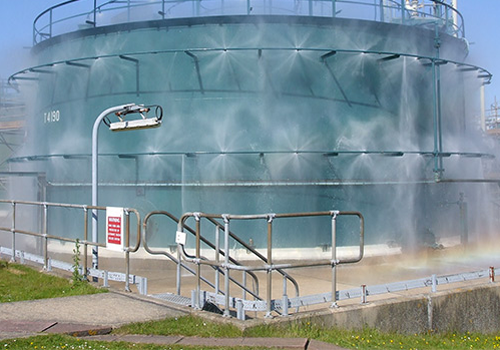
A water spray system operates automatically when fire detectors sense heat or flame. Once activated, the spray nozzles discharge high-pressure water directly onto the fire source within a very short time. This rapid response enables the fire to be controlled or suppressed before it spreads and escalates.
The system is typically integrated with an automatic fire detection or fire alarm system, allowing it to activate immediately upon fire detection. In accordance with applicable standards, any water flow must initiate an audible alarm within 90 seconds after the start of discharge. Alarm devices may include listed mechanical waterflow alarms or horns, as well as listed electrical devices such as bells, speakers, horns, or sirens.
Design Standards Applied
1. NFPA 15
The primary reference for water spray system design is NFPA 15, formally titled “Standard for Water Spray Fixed Systems for Fire Protection.” This standard provides a comprehensive framework covering the design, installation, testing, and maintenance of fixed water spray systems.
The specific objective of NFPA 15 is to ensure effective fire control, suppression, prevention, and exposure protection. These objectives are achieved through stringent requirements governing system design, installation practices, and acceptance testing of fixed water spray systems.
Key implications of NFPA 15 on major water spray system components include:
- In corrosive environments, spray nozzles must be listed as corrosion-resistant, with coatings suitable for chemical exposure and high humidity conditions.
- Water-filled piping is permitted to use plain (carbon) steel. For manual and open systems, steel piping must be galvanized to prevent corrosion.
- Piping systems must be capable of withstanding a minimum water pressure of 175 psig to prevent structural failure during emergency operation.
- Automatic systems require the use of deluge valves, which may be hydraulically, electrically, or mechanically actuated. The closing time of control valves must not be less than 5 seconds at the maximum flow rate from the fully open position.
- Fire Department Connection (FDC) locations must be clearly visible and readily accessible, free from obstructions such as fences, shrubs, trees, walls, or any fixed or movable objects.
2. Additional Design Criteria from FM Global
FM Global applies more stringent and prescriptive design criteria compared to general standards such as NFPA. The objective is not only to suppress fire, but also to prevent loss escalation and minimize business downtime.
Some of the additional requirements commonly specified by FM Global include:
- Redundant automatic water supply, such as standby fire pumps combined with large-capacity (jumbo) water tanks, for large systems exceeding 2,000 gpm, ensuring continued operation even if one pump fails.
- Minimum water reserve duration of 60 minutes for remote transformers, incorporating a 1.5 safety factor over the normal system demand.
- Extra-heavy piping (Schedule 80 or higher), enhanced corrosion protection, and tighter nozzle spacing to ensure effective fire penetration without blind spots.
3. Key Parameters: Spray Density, Coverage, and Discharge Duration
The water application rate (spray density) is a critical design parameter in water spray system design, varying according to hazard type and the intended protection objective. Typical design densities range from 6.1 L/min/m² to 20.4 L/min/m².
Accurate determination of spray density is essential to avoid uneven water coverage, which can significantly reduce the system’s effectiveness in controlling heat and fire. Examples of minimum application rates specified in NFPA 15 for various hazards include:
- For cable trays, cable runs, and belt conveyors (including drive units and conveyor belts), the recommended density range is 6.1 to 20.4 L/min/m².
- A minimum application rate of 20.4 L/min/m² is recommended for equipment handling flammable liquids or gases—such as pumps, compressors, and associated machinery. This higher density is intended to provide effective cooling and vapor suppression
- For flammable or combustible liquid pool fires, the minimum application rate is 12.2 L/min/m², designed to control or extinguish burning liquid surfaces.
- Application rates for fire prevention purposes are typically based on field experience or relevant full-scale fire test data, as prevention hazards are often highly specific and require performance validation.
- Application rates for exposure protection depend heavily on the specific item being protected and its orientation relative to the heat source. Calculations must account for the object’s shape and size, as well as the heat intensity generated by the fire source.
Applications of Water Spray Systems in Industrial Facilities
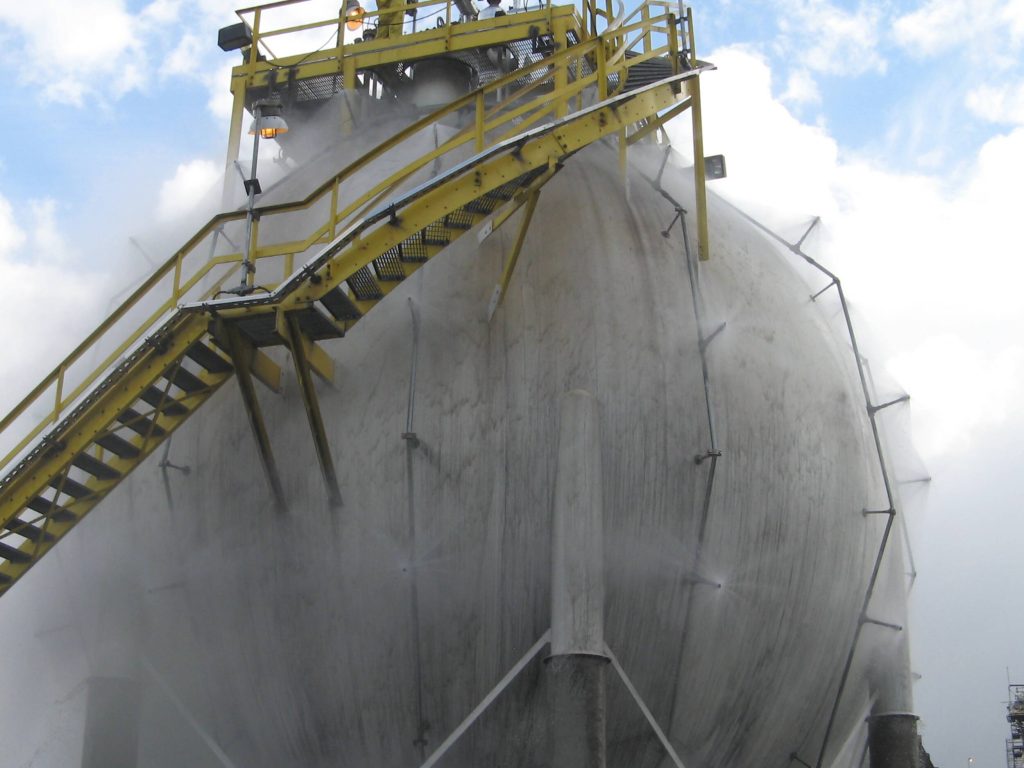
1. Water Spray for Tank Protection
Water spray systems are widely used to protect the external surfaces of flammable liquid storage tanks from excessive heat exposure caused by adjacent fires. The primary objective is not only fire suppression, but also maintaining the tank’s structural integrity, preventing explosions, and limiting fire spread.
The system distributes water through strategically arranged spray nozzles that uniformly cover the tank surface, ensuring the liquid contents remain below critical temperature thresholds. This approach significantly reduces the risk of tank failure and enables more effective fire control in high-hazard areas.
In practice, water spray nozzles are specifically designed and oriented to deliver continuous cooling to the tank shell, allowing heat to be absorbed efficiently and maintaining safe structural temperatures throughout the fire event.
2. Protection of Pipe Racks and Process Equipment
Water spray systems are also applied to protect structures such as pipe racks and process equipment from heat exposure and fire, particularly in open areas or along equipment corridors. This protection strategy helps to:
- Cool steel surfaces and process equipment, preventing loss of material strength due to elevated temperatures
- Control fire spread from one area to adjacent equipment or structures
- Provide continuous exposure protection for vulnerable assets without waiting for manual firefighting intervention
According to industry guidelines, water spray system design is strongly recommended for pipe rack protection where there is a potential for fires involving flammable liquids or combustible fluids beneath the structure. Spray nozzles are typically oriented toward the underside and surrounding areas of the pipe rack to absorb radiant heat and slow or prevent progressive damage.
Example of Water Spray System Design in Industrial Facilities
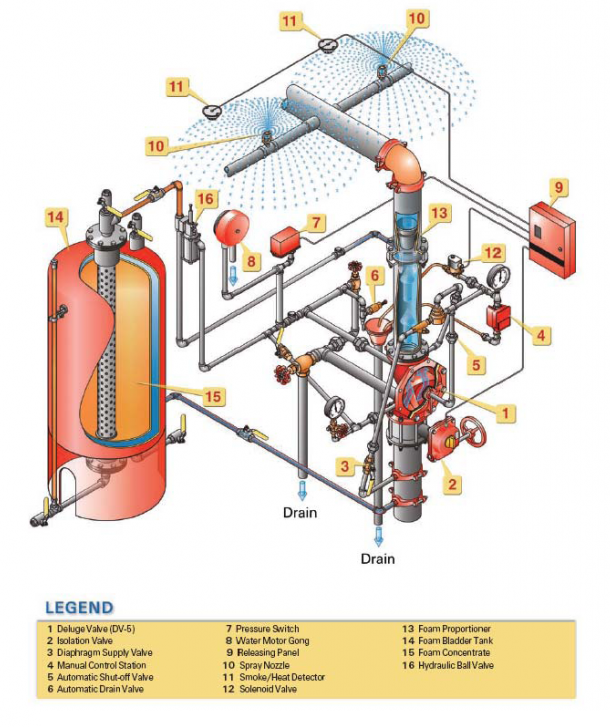
Industrial water spray system design must be executed with a high level of precision to ensure reliable performance under emergency conditions. The following checklist highlights the key requirements that should be satisfied when developing a water spray system design:
- Clear protection objectives
- Detailed hazard analysis
- Robust hydraulic calculations
- Effective spray nozzle placement
- Adequate water supply and system pressure
- Piping materials suitable for environmental conditions
- Proper integration of detection and actuation systems
- Comprehensive testing and commissioning
- System readiness for inspection and long-term maintenance
Meeting these criteria helps ensure the system delivers effective fire control, complies with applicable standards, and remains dependable throughout its service life.
Why Validate Your Water Spray System Design?
A water spray system is a reliable fire protection solution in high-hazard facilities. Many system failures stem not from the overall concept but from incomplete or improperly validated design details — especially in hydraulics and nozzle selection.
For this reason, your facility should engage Lumeshield’s Fire Protection System Design services. Our scope includes determining required spray discharge rates and nozzle K-factors, and performing hydraulic simulations to protect equipment such as transformers, conveyors, and other process machinery.
Ensure your water spray system design complies with applicable standards and prevents catastrophic losses. Contact us today to start your consultation.